
Your AI Agent Doesn't Need a Better Prompt. It Needs a Ceiling
By Tatiana Mikhaleva · Developer Advocate · Docker Captain · CNCF Ambassador · IBM Champion
I stopped writing safety rules into my agents’ system prompts. Here’s the stack that replaced them, and why one acquisition just made the whole thing boring, in the best possible way.
Every other post about “safe AI agents” lands in the same place. Write better guardrails into your prompt. Be more explicit. Add a never do X section and a stern tone. I did exactly that for months. The problem shows up the first time an agent reads “do not touch production without confirmation,” agrees enthusiastically, and reaches for it anyway.
So let me say the thing plainly. A prompt is not a security control. It’s a wish.
A language model is probabilistic by construction. When you write “never spend more than the budget” or “never open a public port,” you are not setting a hard limit. You are nudging a token predictor and hoping the nudge holds under pressure. It usually does. Until the one time it doesn’t, on a Friday evening, against the “unused” database that turns out to be load-bearing for somebody’s revenue. Autonomy without a hard boundary isn’t innovation. It’s catastrophe at machine speed.
The interesting question was never how do I make the agent smarter. It’s what can this agent physically not do, no matter what it decides. And the honest answer, for the first time, is: quite a lot. Most of it shipped in the last few months, and most of it now lives under one roof.
The boundary doesn’t live in the prompt
So where does the boundary live, if not in the prompt? Over the last few months it moved down into the infrastructure layer. The clearest evidence is what HashiCorp shipped for native agentic identity in May 2026. The secrets handling is solid. But the part worth slowing down on is the authorization model, because it’s what turns please behave into you can’t.
Here it is, because it’s the whole article. An agent’s permitted action is the intersection of three policies: the human it’s acting for, the agent’s own policy, and a ceiling that nobody, human or machine, is allowed to cross. On top of that, the authorization is scoped to the specific request and expires with it.
Read that twice. The agent never holds a standing key. It receives a temporary, request-shaped permission that is the narrowest of what the human may do, what the agent may do, and what the ceiling allows. Traditional IAM was built for deterministic users doing predictable things. This is built for a non-deterministic actor that changes behavior at runtime every time it picks a different tool. Which is exactly the threat model everyone was hand-waving about a year ago.
A few things fall out of this the moment you build on it instead of arguing with the model:
Dynamic secrets instead of hardcoded ones. The agent needs database access to refactor a schema? It never finds a password in a .env file. Vault issues a short-lived, identity-bound credential that dies on a timer. If the agent hallucinates and dumps its credentials into a log, they’re already worthless.
Every action is attributable. In HashiCorp’s validated pattern, the path Web → Agent → MCP server → Vault carries one correlation identifier end to end. When something goes wrong, you don’t ask “what did the AI do.” You pull the trace and see precisely whose authority the agent was borrowing, for which request, and what it touched.
Policy-as-code does the enforcing, not goodwill. The agent can generate elegant, fast Terraform. If that Terraform creates an S3 bucket without encryption, Sentinel rejects the plan before it applies. The rule is enforced by a machine. It does not care how confident the model sounded.
None of that is a better prompt. All of it is a wall.
What IBM quietly assembled
While the rest of the industry argued about how to make agents behave, IBM was buying the parts to make sure they can’t misbehave. The cage already exists. One company just spent the last year bolting the bars together.
IBM closed its $6.4 billion acquisition of HashiCorp in February 2025. At HashiConf 2025, HashiCorp’s first conference as an IBM company, the direction stopped being abstract. MCP servers for Terraform, Vault, and Vault Radar gave AI agents a governed, role-scoped, auditable way to act on infrastructure, instead of handing them broad API tokens and praying. Then in May 2026, Vault shipped the native three-policy agentic identity model I just walked through, and at Think 2026 the secrets layer rolled forward into Vault Enterprise 2.0.
Stack it up and the shape is obvious.
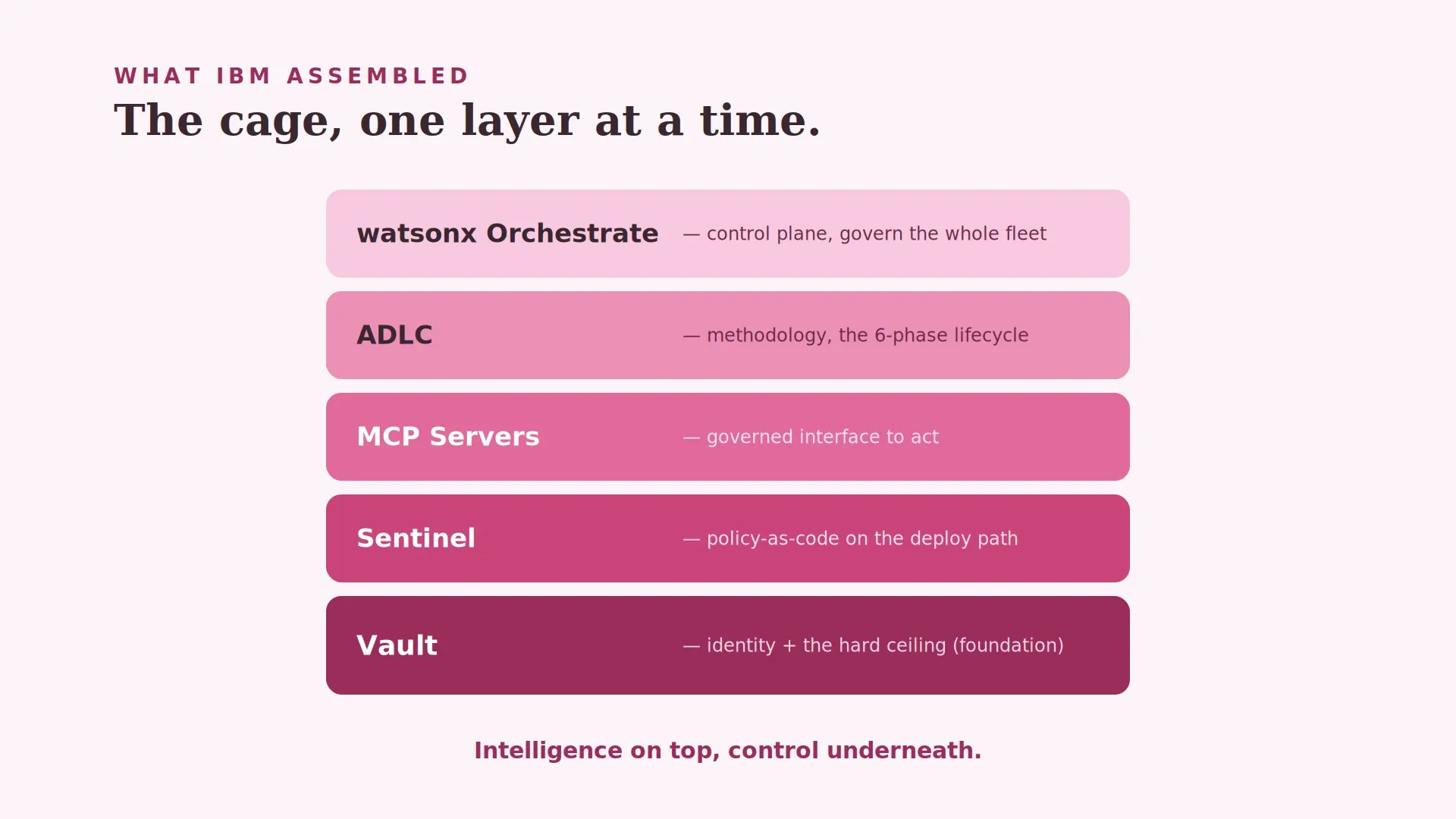
Identity and a hard ceiling at the bottom: Vault. Policy-as-code on the deploy path: Sentinel. A governed interface for the agent to even reach your infrastructure: MCP servers. And over the top, a methodology. IBM published Architecting Secure Enterprise AI Agents with MCP (verified by Anthropic), introducing the Agent Development Lifecycle (ADLC): six phases (Plan, Code & Build, Test & Release, Deploy, Operate, Monitor) that extend DevSecOps for stochastic, tool-using agents, with an MCP Gateway that centralizes authorization, policy, rate limits, and audit. I walk through all six phases, one at a time, here. Treat agents not as static applications you ship once, but as long-running systems you continuously evaluate, secure, and govern.
And then there’s the control plane. watsonx Orchestrate now governs an organization’s agent fleet across frameworks (IBM-native agents, Langflow, LangGraph, agents built on the open A2A protocol) through one operational layer, with AgentOps providing lifecycle observability and real-time policy enforcement. The problem watsonx Orchestrate is built to solve has a one-word name: sprawl. Agents are being spun up in every team, on every framework. Without a single place to run, govern, and observe them, you don’t have automation. You have a very fast mess with dashboards.
The practical takeaway for anyone running a platform team: stop building this yourself. I keep meeting teams burning senior-engineer quarters on homegrown sandboxes and wrapper scripts to stop AI tools from breaking things. Pure, unbillable R&D inside companies whose actual job is retail, or fintech, or streaming. The primitives are assembled now. Hand-rolling a worse version of Vault’s ceiling is no longer brave, just expensive.
What’s real, and what’s still a slide
I’m an IBM Champion. Let me use that to be useful instead of to cheer.
What has actually shipped, and you can build on today: Vault’s native agentic IAM, the MCP servers (beta, but real), Sentinel, watsonx Orchestrate with AgentOps, and the ADLC guide. That is a working foundation, not a roadmap.
And what is still a bet? Project Infragraph, HashiCorp’s real-time infrastructure graph designed to be the context layer an agent reasons over, opened as a private beta in December 2025 and reached public preview at Think 2026 in May 2026, delivered as “HCP Terraform powered by Infragraph.” But it’s still beta, US-only, and HashiCorp itself discourages pointing it at production workflows. The vision is that the same graph will eventually let AI reason about infrastructure state, propose runbooks, and act across the lifecycle, and to connect outward to the broader IBM portfolio, including Red Hat Ansible, OpenShift, watsonx Orchestrate, Concert, and Turbonomic. That vision is the right one, because it answers the oldest objection to autonomous agents: the agent doesn’t know your business context. But it is a bet. Architect on the cage (Vault, Sentinel, the MCP gateway), which is production-grade today. Pilot the context brain. Don’t bet your 2026 on a beta the vendor won’t yet aim at production, however good the demo looks.
That distinction is the whole point of reading independent analysis instead of a press release.
The job changes, it doesn’t disappear
We’re moving from hand-writing configuration to intent-based operation. Machines will write the infrastructure code. That isn’t a forecast anymore. It’s a release note.
But your value as a Head of Platform or an architect doesn’t evaporate with it. It moves. You stop reviewing every line of YAML before the merge and start designing the boundary instead: where Vault’s ceiling sits, what Sentinel rejects, which gateway the agent reaches through, which ADLC phases every agent clears before it sees production. You used to be the last pair of eyes before the merge. Now you’re the architect of the cage the machine runs full-speed inside, and physically cannot break the things that must not break.
That’s the end of TicketOps, and honestly, good riddance.
So. This one is for the platform leads. Stop writing your agents polite instructions and hoping they hold. Stop spending senior time reinventing a worse Vault. Put that time into the architecture of the boundary instead. This was the conversation across this spring’s conference floors, RSAC in March, Think 2026 in May: the industry has finally stopped asking how clever we can make the agent and started asking how tightly we can bound it.
That was always the more interesting question. The future doesn’t belong to whoever has the smartest agent. It belongs to whoever knows, precisely, what their agent can’t do.